
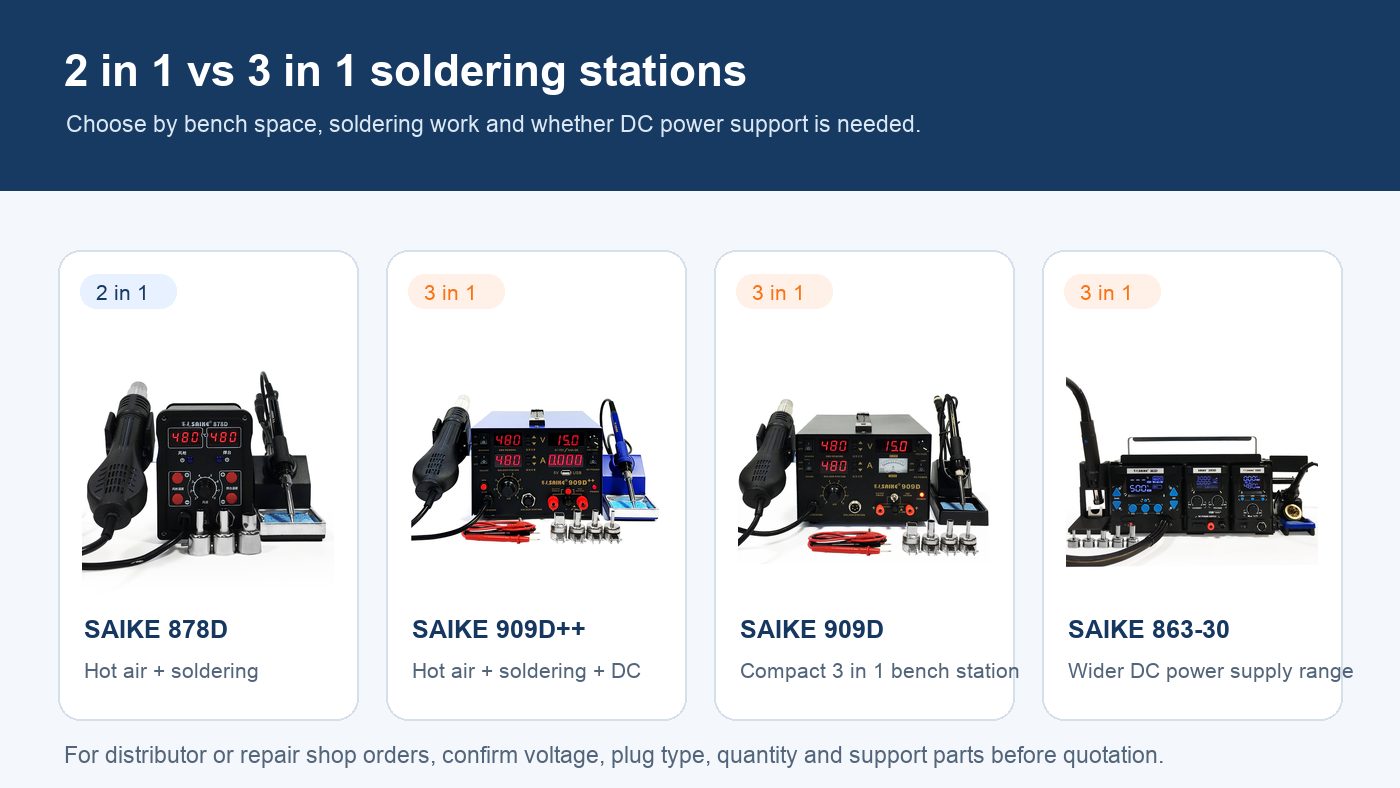
A 2 in 1 soldering station and a 3 in 1 soldering station can look similar at first, but they are built for different bench needs. The right choice depends on whether the repair work needs only hot air and soldering, or also needs DC power supply support for testing.
This guide compares the two setups from the buyer's point of view: repair task, bench space, daily workflow, accessory support and quotation requirements.
Quick Answer
Choose a 2 in 1 station if the bench mainly needs hot air and soldering in one compact machine. Choose a 3 in 1 station if the same bench also needs DC power supply support for testing, training or wider repair work.
Main Difference
| Setup | Main functions | Best fit |
|---|---|---|
| 2 in 1 soldering station | Hot air + soldering | Phone repair, PCB repair, daily maintenance and compact repair benches. |
| 3 in 1 soldering station | Hot air + soldering + DC power supply | Repair shops, training benches and buyers who want a more complete all-in-one setup. |
When a 2 in 1 Station Makes Sense
A 2 in 1 station is a practical choice when the buyer wants hot air and soldering in one machine, but does not need a built-in DC power supply. It keeps the bench simple and avoids buying a larger station when voltage testing is handled by a separate device.
This setup is often suitable for:
- Phone repair and small electronics repair.
- SMD rework and soldering on the same bench.
- Repair shops that already have a separate DC power supply.
- Buyers who want a compact tool for common repair tasks.
For this direction, see the 2 in 1 Hot Air Soldering Station category and SAIKE 878D.
When a 3 in 1 Station Is Better
A 3 in 1 station is better when the buyer wants a more complete bench setup in one machine. It adds DC power supply support, so the station can support heating, soldering and basic power testing in one unit.
This setup is often suitable for:
- Repair shops building a starter bench.
- Training benches that need one clear equipment direction.
- Distributors preparing repair tool packages.
- Buyers who want fewer separate machines and cables on the bench.
- Repair work that often needs voltage output or basic board testing support.
For this direction, see the 3 in 1 Hot Air Soldering Station category, SAIKE 909D++, SAIKE 909D and SAIKE 863-30.
Model Direction
| Buyer need | Suggested direction |
|---|---|
| Compact hot air and soldering station | 2 in 1 station such as SAIKE 878D. |
| Complete bench station with DC support | 3 in 1 station such as SAIKE 909D++ or 909D. |
| Wider DC power supply requirement | Consider SAIKE 863-30. |
| Unsure between several station types | Start from repair task, quantity, voltage and accessory requirements. |
Accessory and Support Considerations
The machine type also affects the accessories a buyer may want to quote together. For 2 in 1 and 3 in 1 stations, useful optional support can include hot air nozzles, hot air handles, heating elements, soldering iron handles, soldering tips and common bench consumables.
For distributor orders, this matters because the buyer may need to support the machine after resale. A repair shop may also want spare parts and working accessories together with the first machine order.
What to Confirm Before Quotation
Before choosing between 2 in 1 and 3 in 1, confirm:
- Main repair task and application.
- Whether DC power supply support is required.
- Voltage and plug type.
- Order quantity.
- Destination country.
- Whether spare parts, nozzles, soldering tips or consumables should be quoted together.
If you are not sure which setup fits your repair work, contact SAIKE with your repair task, quantity and destination country. We can help recommend a suitable model direction and quotation plan.
Send your repair scenario, model requirement and quantity. We can help confirm suitable hot air rework stations, soldering tools, power supplies or repair kit options.
Contact SAIKE